Pedalinho Tox Edition Report a problem
Your pedals, on the screen,
while you play.
A browser editor for twenty-one guitar and bass multi-effects families — BOSS Katana, GT-1000, GT-1B, ME-90, Zoom MS, MS Plus and G-series, Valeton GP, Hotone Ampero, Pocket Master. Read the patch that is in the pedal, change it, write it back. Nothing to install, no account, nothing uploaded.
Open the editor →21 device families (4 with fixture tests that pass) · read and written, over the cable you already own · each family marked confirmed only after a bench session with the real unit.
One app, twenty-one editors
Each family gets the editor its own protocol deserves, not a generic slider grid.
- BOSS — Katana MkII (full editor, confirmed on hardware), Katana MkI (built from the published map; nothing is written until the amp identifies itself), Katana Gen3 (read and write; the amp identifies itself before anything is written), GT-1000 (parameters rendered live from the unit), GT-1B, ME-90.
- Zoom — G5n and MS-200D+ (both confirmed on hardware); the MS Plus line, MS-50G+, MS-60B+, MS-70CDR+ and MS-80IR+, on the 200D+'s protocol; MS-50G, MS-60B, MS-70CDR, each with its own parameter map; and the B1on.
- Valeton — GP-5 over Bluetooth, and the GP-50 and GP-200 as pilots.
- Hotone — Ampero: what the unit confirms it can read, nothing more.
- Pocket Master — Bluetooth LE, its own command library rather than MIDI.
- Generic MIDI — a raw editor for anything else that speaks SysEx.
What you can actually do
- Read a patch off the pedal and see every control on one screen, not a menu tree.
- Change it and write it back while you play.
- Keep a library of patches, and send any of them to any channel.
- Translate patches between devices — a preset built for one family, mapped onto another.
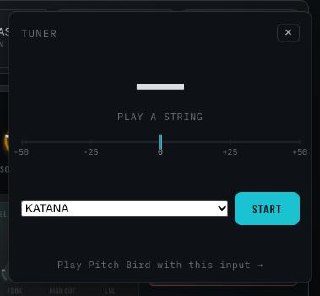
- Run a setlist, step through songs and tones, tune with the amp's own USB audio, and play along with a backing track.
Patch files, plainly
Supported means a real file has gone in and come back out unchanged. Everything else says what it is.
- Katana MkII .tsl — supported: a real BOSS Tone Studio liveset is read and written back with every key and value intact.
- Katana MkI .tsl (the older file BOSS labels “GT”) — documented: read from the published format; no real file has proven the round trip yet.
- Katana Gen 3 .tsl — recognised, not installable yet.
- Zoom patches saved as .tsl — named as Zoom patches, not imported as BOSS livesets.
Before you click
- Use Chrome or Edge on a desktop computer. The connection needs Web MIDI, which Safari and Firefox do not provide. On an older Chrome the page will say so rather than fail quietly.
- Connect the Katana by USB and switch it on.
- If the browser asks for permission to use MIDI devices, allow it — that is the cable.
What it does
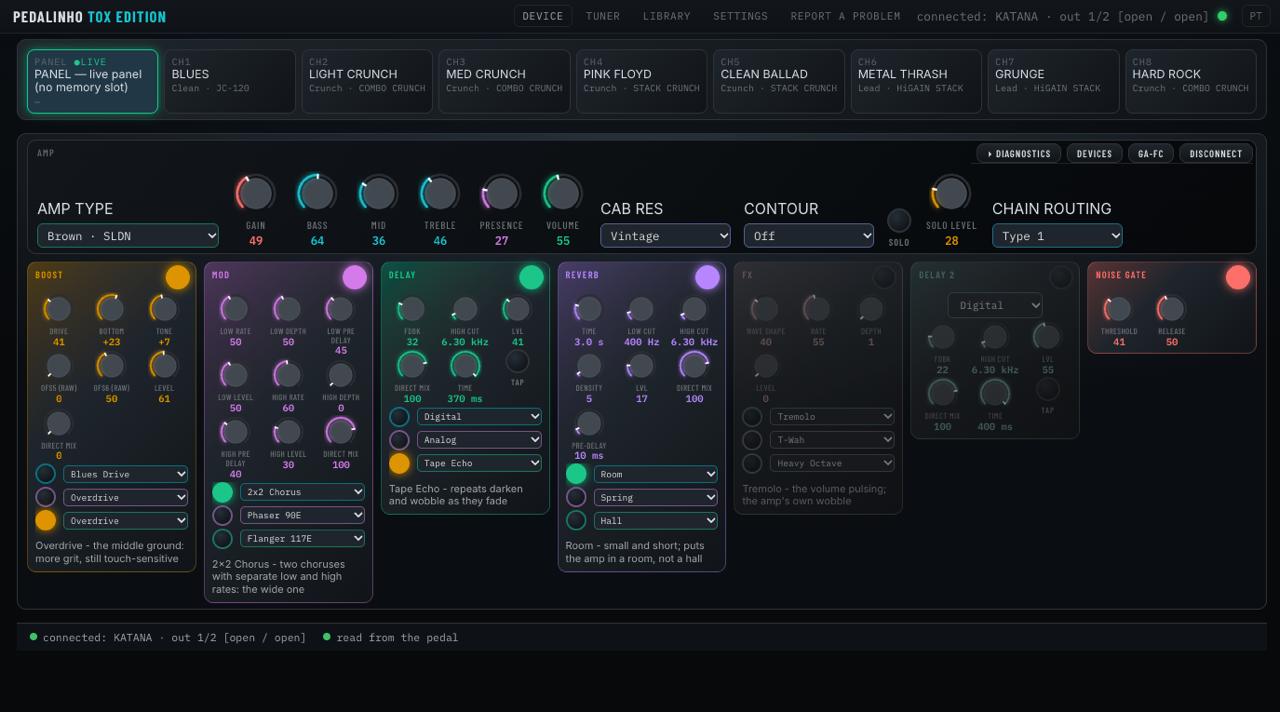
- Reads the patch on the amp and shows the whole chain on one screen — amp, boost, the effects, the delays and the reverb, with real values instead of raw numbers.
- Changes travel to the amp as you make them. Save when you are happy.
- Works on the Katana MkII. Read-only where a control has not been confirmed on real hardware — it says so rather than guessing.
Honest notes
- This is a personal project, not a product. It is not affiliated with, endorsed by, or connected to BOSS or Roland; product names are used only to say what it talks to.
- Anonymous usage telemetry is collected — which screens are opened and whether operations succeed — so failures get found. No accounts, no personal data, no audio, nothing sold.
- It is young. If something is wrong, a wrong value is worse than a missing one, so controls without confirmed addresses are deliberately not writable yet.